In order to get to Lima on the cheep I had to fly through Bogota, Columbia (not the cheapest option…that was to go through Miami but I thought that was a little excessive) which was an interesting experience. While travelling through Columbia I was expecting that there would be a lot of security, issues being a North American in Columbia and issues coming from Ecuador given the skirmish that transpired between the two countries. But in the airport I had no problems with security at all and didn’t even have my passport reviewed by anyone but airline personnel. The only hiccup I had was carrying a bottle of water (same in any airport) that caused the security guard to frisk me (but I’ve been frisked at other airports, so that was no big deal).
When I arrived in Lima I had to wait a bit for Susy to come and pick me up before heading to her place to meet everyone in her family, my home for the next week. That evening and rest of the day was very uneventful as all I did was hang out and get to know the family with which I was going to live and go for a walk with Diego (Susy’s oldest son) around the area. The next day though was a different story and I got to explore the city of Lima. From what Fernando (Susy’s husband) told me when I first arrived, Lima is a great city to live in as there are lots of things to do if you live there, but for tourists, there’s nothing to do, and as I found out on Sunday, he was right.
In the morning I headed out with Diego to visit the historic centre of the city. The main place Susy felt we should visit was the Plaza de Armas, the main square in the historic centre where the President lives. After we wandered around the square we headed over to the Plaza San Francisco which has monastery set up by the San Franciscan order. The highlight of this monastery are the catacombs below the church that house a couple thousand bodies, but when the archeologists went through, one of them decided to arrange the bones in interesting patterns of spirals and sticking skulls in the holes around the catacombs. It was more than creepy and confined since I couldn’t stand up anywhere in the entire network of catacombs. After Diego and I finished the tour there we headed off to the museum of the Spanish Inquisition, a museum detailing the inquisition’s activities in South America located in the building that housed the inquisition’s headquarters in Latin America. I spent the afternoon with Susy going down to the “tourist” are in Lima known as Miraflores. As this wasn’t Susy’s favorite place in the city, we just walked very quickly around the streets before heading back to the house.
Monday was a pretty uneventful day. I had my two hours of classes in the morning, then went for a walk around the house looking for an internet café and stopped at a coffee shop to relax and read a book (and search for AC….Lima is hot), and followed that up with another two hours of Spanish classes. Tuesday ran pretty much the same way (well, I did say there wasn’t much to do in Lima) but instead I headed down to Miraflores to explore Larcomar. While I was there I had to take out some money only to find out that I couldn’t use my card. With only $3 I had to do something quick or else I wouldn’t even be able to make it home that night. I called Canada to look for help and visited four different banks before I finally found one that would allow me to take money out, and from then on I only used that bank….but it was quite nerve-racking not being allowed to take out money.
Wednesday went much the same, but I opted to head down to the historic centre again which was pretty uneventful and I didn’t see anything new or different, I just thought that if I went without Diego I would spend more time exploring the area, but alas I didn’t, mainly because I didn’t feel 100% safe taking my camera out while I was down there. I was also quite harassed walking down one of the pedestrian streets. But luckily, instead of having class in the afternoon I went with Diego to the market to look at all the different fruits they have in Peru so I could try them all. I was fascinated with the number of different types of fruit they had (less than Ecuador though) but more entertained by Diego who was shocked that we had some of the fruit they had (like apples and bananas….although they did have 13 different kinds of bananas and entire fruit stands dedicated to only bananas).
That evening though I had a problem with Volunteer Visions in that they wanted to charge me for the bus ticket down to Pisco and the first two days I had with Susy and her family. I was irate that they wanted to charge me so much money (had I done it all on my own I would have paid less than a third of the cost) for something that I had already paid for in my volunteer fees (it included airport pickup and transportation to and from the volunteer project, it also required that I arrive two days ahead of the start of my project…ie. Arrive on Saturday). I was more than irate and didn’t feel that I should pay this and after all the issues I had with volunteer visions it was the straw that broke the camel’s back.
On Thursday I headed to the National Museum which took a little more than a bit of guessing game of which bus to take as it was located in an area that I didn’t know. But by the time I made it there I had another problem….the museum was closed until I headed back to Canada, so instead I decided to head back downtown to Miraflores to spend the afternoon. That evening though we had a special treat as it was Diego’s birthday. As part of the birthday celebrations, Susy takes the boys to the local grocery store to go shopping for the birthday cake they want. A different but great way to celebrate your birthday.
Friday I went back to Miraflores to relax before I went off to Pisco. I also decided to look for the Canadian embassy to see if I could get any tourist information that I could use to show Diego pictures of Canada and some information about what life is like in Canada as he was quite interested about the differences between Canada and Peru. That evening I said goodnight and goodbye to the family.
Friday, March 28, 2008

Friday, March 21, 2008
Mar. 21 - Good Friday Procession
The main reason I wanted to stay in Ecuador for Samana Santa was to be in Quito for the Good Friday procession. It was supposed to be the best Easter celebration in Ecuador. So Anna and I joined some people from the hostel and headed down to the historic centre of Quito with what appeared to be everyone else in the city.
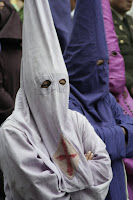 Even though we arrived early for the procession, we were quite nervous that we woudl be late, because when we arrived the street was already filled with people in the parade. It turns out there isn't enough space in the old city for a staging area, instead everyone is forced to set up for the parade in the street. This takes up a sizeable amount of space as there were easily more than 2,000 people in the procession.
Not long after noon the parade started. The vast majority of the participants were Cucurachos, people dressed in purple from head to foot and wearing a cone like cap that covered their faces. They were all participating in order to absolve their sins from the past year and most were carrying a picture or statue of either Jesus or the Virgin Mary. There were literally thousands of them; men, women, young and old.
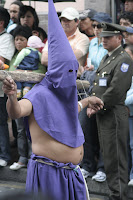 The other participants in the procession were dressed as Jesus and carried crosses, some of which were so heavy they needed help from other people in the parade. Some of these men were even being lightly whipped to symbolize the suffering of Christ.
We were so taken by the procession that Joe and I decided to find the front of the procession and join it. Armed with our cameras we knew that we would have no problem breaking through the ranks of spectators (estimated to be more than 500,000 people) to actually join the procession.
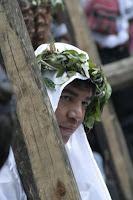 We were right. The police and people had no problem with us being around with the procession (we actually were ignored by the police when we were in the middle of the parade, but when we were on the side we were asked to step back). We were able to take so many great pictures, especially of a man who against the advice of the paramedics surrounding him, insisted on carrying his cross. Later that night when I transferred the pictures to my hard drive, I didn't notice that only a handful had transferred before I deleted them all .... I won't make that mistake again.
That night, all of us went out to the Coffee Tree for one final night in Ecuador before my flight to Lima the next day.
 Even though we arrived early for the procession, we were quite nervous that we woudl be late, because when we arrived the street was already filled with people in the parade. It turns out there isn't enough space in the old city for a staging area, instead everyone is forced to set up for the parade in the street. This takes up a sizeable amount of space as there were easily more than 2,000 people in the procession.
Not long after noon the parade started. The vast majority of the participants were Cucurachos, people dressed in purple from head to foot and wearing a cone like cap that covered their faces. They were all participating in order to absolve their sins from the past year and most were carrying a picture or statue of either Jesus or the Virgin Mary. There were literally thousands of them; men, women, young and old.
 The other participants in the procession were dressed as Jesus and carried crosses, some of which were so heavy they needed help from other people in the parade. Some of these men were even being lightly whipped to symbolize the suffering of Christ.
We were so taken by the procession that Joe and I decided to find the front of the procession and join it. Armed with our cameras we knew that we would have no problem breaking through the ranks of spectators (estimated to be more than 500,000 people) to actually join the procession.
 We were right. The police and people had no problem with us being around with the procession (we actually were ignored by the police when we were in the middle of the parade, but when we were on the side we were asked to step back). We were able to take so many great pictures, especially of a man who against the advice of the paramedics surrounding him, insisted on carrying his cross. Later that night when I transferred the pictures to my hard drive, I didn't notice that only a handful had transferred before I deleted them all .... I won't make that mistake again.
That night, all of us went out to the Coffee Tree for one final night in Ecuador before my flight to Lima the next day.
Thursday, March 20, 2008
Mar. 18-20 - Too tall for a mule, too heavy for a llama
After leaving Baños we headed to the town of Tigua on the Quilotoa loop (the Quilotoa loop is a popular circuit through the mountains that allows you to visit many different small indigenous communities and provides unparalled hikes through mountains, canyons and volcanic lakes. It is supposed to be one of the most beautiful areas in the Ecuadorian Andes). Tigua is less of a town and more of a collection of houses on the side of the road ... population 14. When we got off the bus we found the only place to stay in town was closed for a month, and the next place to stay was 6km away (the closest one for about 50km). The girl on the side of the road with whom we were talking offered to get her father to drive us down to the next hacienda. When he came down, it turned out he was Alfredo Toaquiza, the famous Tigua artist who has had shows all over the world and is imitated by artists throughout Ecuador (Tigua art is painted on sheep skin and portrays images of the Tigua culture). After dropping us off at Posada de Tigua, we assured him we would stop by his gallery the next day.
We happened to get the last room available in the hacienda. The Posada de Tigua, like most places along the Quilotoa Loop is an ecolodge. Before it turned into an ecolodge, this 125 year old farm was a dairy farm that no longer was profitable after the dollarization of the Ecuadorian economy (the price of one gallon of milk dropped by more than 80%). In order to keep the farm open, the family has converted it into an ecolodge. All the meals consist of food from the farm and they have created a lovely homey feel within the old farmhouse, complete with a large dinning room table aroudn which all the guests eat and mingle during meal times.
In the morning we had the most amazing breakfast (I’ve never had food as good as they provided at this hacienda) and then started on our way to Laguna Quilotoa. As bus service on the Quilotoa loop is limited, we were forced to start off on foot until we found a bus or car that would give us a lift. An hour and a half later we managed to find a bus (the third vehicle to pass us on the road) that took us to Zumbahua where we caught a cambioneta to the lake.
 The Laguna Quilotoa is a volcanic lake that formed inside the rim of a volcano’s crater. Since there is no water entering or leaving the lake it creates a beautiful blue colour surrounded by jagged cliffs (don’t drink the water since it is full of dangerous minerals). There is a trail from the rim to the bottom and another that goes around the rim. We opted to go down to the lake. The hike down was fantastic but rather steep, so I opted to take a mule back to the top. This proved rather difficult as I was a little too tall for the mule and my feet kept dragging on the ground. At one point my guide asked me to get off the mule to let it rest. The ride up was rather interesting as the mule kept walking to the edge of the cliff before it turned around ... so close that I was actually hanging over the edge ... and the only thing I had to hold onto was the mane of the animal.
 After getting off the mules, we started our walk back to Zumbahua. This walk followed the road as it wandered through farms, small towns and eventually around ravines. It was a magnificent walk that was enjoyed by all. Once back in Zumbahua we caught a bus back to our hacienda, but I got off early in Tigua to visit the art gallery.
It turned out that the gallery was closed, so I walked around town to see if Alfredo was around to open it up for me. In the whole town I could only find one person, who told me to go to the house next door to visit another artist. This house happened to belong to Julio Toaquiza, the father of Alfredo and the person who started the Tigua art form. After talking to him for a while I bought a painting and started walking back to the hacienda. Luckily I happened upon two of the family members who drove by and gave me a lift. They informed me that before dinner I would be able to try and ride a llama.
 The hotel owns a few llamas ... some for protecting the sheep, and others for guests to ride. They put a blanket on some llamas and I climbed on the back of one and went for a ride, only to find out that the llama kept buckling and falling down. We thought this was because they were tired, but it turns out it was because I was too heavy. I had to walk back beside my llama. I was so tall that riding it was more like walking with a llama between my legs.
 The next morning we left early in hopes of making it to Saquisilí, a town just north of Latatunga. (Interesting fact, Cotopaxi’s eruptions wiped out Latacunga completely, three different times over 150 years, and the town kept rebuilding itself at the same spot. You would think that after the second time they would move the town a little bit.) Saquisilí market is one of the most important in Ecuador from an economic standpoint. While you walk the streets you can tell how important it is as the market is everywhere you look. There are six main markets (one of which is only for potatoes) and the streets are filled with other shops. After we had our fill of the markets, we headed off to Quito for the afternoon and evening.
We happened to get the last room available in the hacienda. The Posada de Tigua, like most places along the Quilotoa Loop is an ecolodge. Before it turned into an ecolodge, this 125 year old farm was a dairy farm that no longer was profitable after the dollarization of the Ecuadorian economy (the price of one gallon of milk dropped by more than 80%). In order to keep the farm open, the family has converted it into an ecolodge. All the meals consist of food from the farm and they have created a lovely homey feel within the old farmhouse, complete with a large dinning room table aroudn which all the guests eat and mingle during meal times.
In the morning we had the most amazing breakfast (I’ve never had food as good as they provided at this hacienda) and then started on our way to Laguna Quilotoa. As bus service on the Quilotoa loop is limited, we were forced to start off on foot until we found a bus or car that would give us a lift. An hour and a half later we managed to find a bus (the third vehicle to pass us on the road) that took us to Zumbahua where we caught a cambioneta to the lake.
 The Laguna Quilotoa is a volcanic lake that formed inside the rim of a volcano’s crater. Since there is no water entering or leaving the lake it creates a beautiful blue colour surrounded by jagged cliffs (don’t drink the water since it is full of dangerous minerals). There is a trail from the rim to the bottom and another that goes around the rim. We opted to go down to the lake. The hike down was fantastic but rather steep, so I opted to take a mule back to the top. This proved rather difficult as I was a little too tall for the mule and my feet kept dragging on the ground. At one point my guide asked me to get off the mule to let it rest. The ride up was rather interesting as the mule kept walking to the edge of the cliff before it turned around ... so close that I was actually hanging over the edge ... and the only thing I had to hold onto was the mane of the animal.
 After getting off the mules, we started our walk back to Zumbahua. This walk followed the road as it wandered through farms, small towns and eventually around ravines. It was a magnificent walk that was enjoyed by all. Once back in Zumbahua we caught a bus back to our hacienda, but I got off early in Tigua to visit the art gallery.
It turned out that the gallery was closed, so I walked around town to see if Alfredo was around to open it up for me. In the whole town I could only find one person, who told me to go to the house next door to visit another artist. This house happened to belong to Julio Toaquiza, the father of Alfredo and the person who started the Tigua art form. After talking to him for a while I bought a painting and started walking back to the hacienda. Luckily I happened upon two of the family members who drove by and gave me a lift. They informed me that before dinner I would be able to try and ride a llama.
 The hotel owns a few llamas ... some for protecting the sheep, and others for guests to ride. They put a blanket on some llamas and I climbed on the back of one and went for a ride, only to find out that the llama kept buckling and falling down. We thought this was because they were tired, but it turns out it was because I was too heavy. I had to walk back beside my llama. I was so tall that riding it was more like walking with a llama between my legs.
 The next morning we left early in hopes of making it to Saquisilí, a town just north of Latatunga. (Interesting fact, Cotopaxi’s eruptions wiped out Latacunga completely, three different times over 150 years, and the town kept rebuilding itself at the same spot. You would think that after the second time they would move the town a little bit.) Saquisilí market is one of the most important in Ecuador from an economic standpoint. While you walk the streets you can tell how important it is as the market is everywhere you look. There are six main markets (one of which is only for potatoes) and the streets are filled with other shops. After we had our fill of the markets, we headed off to Quito for the afternoon and evening.
Tuesday, March 18, 2008
Mar. 16-18 - Beautiful Baños
The bus ride from Riobamba to Baños was interesting. As we left Riobamba we were able to catch a good look at Chimborazo as we drove by, but lost site of it as we turned off the highway onto a secondary road. From there it appeared as if each road we turned onto diminished in quality until we were on probably the smallest country road in the world. Anna and I were starting to wonder if this bus was even heading to Baños when we caught sight of Volcán Tungurahua puffing away in the distance, before arriving in Baños.
Baños is a small town situated in a valley at the base of Tungurahua (there is a small hill between the town and the volcano that protects the town from eruptions ... but the tourist maps still outline evacuation routes and eruption meeting points). It is the entry point for the Amazon and an adventure sport paradise with hiking, climbing, rafting, bungee jumping and even repelling down waterfalls.
Our first night in town we opted to do some looking around and get a feeling for the town. Baños is a rather small town with some very lovely parks and a cathedral that lights up beautifully at night. After dinner Anna and I headed to the roof of the hostel to enjoy the beautiful night, stars and cool air.
 The next morning we slept in before heading out on a biking adventure. From Baños we started on our bike ride down towards Puyo, over 60km of downhill (road) biking. I think that by the time we reached the end of our ride, there were maybe three uphill stretches, but they were so minimal they very well might have been flat stretches. This bike ride is along on of the most beautiful stretches in Ecuador. Clinging on to the side of the cliffs of a ravine you wind your way around the hills from the sierra to the jungle. Along the way there are numerous tunnels for the cars to go through, but since there are no lights in the tunnels, they suggest that bikes take detours around the tunnels on the secondary road (except for the first tunnel ... there is no detour so you have to just giv’er and pray there are no cars). These detours were the best part of the ride since they were on the most precarious of cliffs. One of these detours actually required we bike under a waterfall…but none of us complained about a little shower to help cool off.
 Aside from the scenery, waterfalls were the main attraction for the ride. As we had seen so many waterfalls, we were a little tired of them so decided to skip most of them and head directly to Pailón del Diablo. These are the most spectacular waterfalls around Baños and are the site of a photo that inspired me to come to South America. These waterfalls are located at the bottom of a ravine where you have to cross a wooden suspension bridge that hangs over the river below. From there you are able to see the magnificent Pailón del Diablo. I must have taken about 100 pictures of that waterfall as I wanted to capture the feeling I saw in that picture while still in Canada. On the other side of the bridge was a cabana with a restaurant that provided a wonderful view of the waterfall, where we ate lunch and watched the condor pass by.
 We decided to take a cambioneta back to Baños instead of a bus so as to better enjoy the views, and in this particular one we were able to stand up for a better view (I did keep in mind the story about the Japanese tourists in Riobamba). Once back in Baños I treated myself to a relaxing massage before heading to the hot springs for a wonderful evening.
In the morning I opted to stay in town, instead of going for a hike with the rest, as I was feeling a little under the weather. Once they all returned we got a bus to our next stop, the Quilotoa Loop.
Baños is a small town situated in a valley at the base of Tungurahua (there is a small hill between the town and the volcano that protects the town from eruptions ... but the tourist maps still outline evacuation routes and eruption meeting points). It is the entry point for the Amazon and an adventure sport paradise with hiking, climbing, rafting, bungee jumping and even repelling down waterfalls.
Our first night in town we opted to do some looking around and get a feeling for the town. Baños is a rather small town with some very lovely parks and a cathedral that lights up beautifully at night. After dinner Anna and I headed to the roof of the hostel to enjoy the beautiful night, stars and cool air.
 The next morning we slept in before heading out on a biking adventure. From Baños we started on our bike ride down towards Puyo, over 60km of downhill (road) biking. I think that by the time we reached the end of our ride, there were maybe three uphill stretches, but they were so minimal they very well might have been flat stretches. This bike ride is along on of the most beautiful stretches in Ecuador. Clinging on to the side of the cliffs of a ravine you wind your way around the hills from the sierra to the jungle. Along the way there are numerous tunnels for the cars to go through, but since there are no lights in the tunnels, they suggest that bikes take detours around the tunnels on the secondary road (except for the first tunnel ... there is no detour so you have to just giv’er and pray there are no cars). These detours were the best part of the ride since they were on the most precarious of cliffs. One of these detours actually required we bike under a waterfall…but none of us complained about a little shower to help cool off.
 Aside from the scenery, waterfalls were the main attraction for the ride. As we had seen so many waterfalls, we were a little tired of them so decided to skip most of them and head directly to Pailón del Diablo. These are the most spectacular waterfalls around Baños and are the site of a photo that inspired me to come to South America. These waterfalls are located at the bottom of a ravine where you have to cross a wooden suspension bridge that hangs over the river below. From there you are able to see the magnificent Pailón del Diablo. I must have taken about 100 pictures of that waterfall as I wanted to capture the feeling I saw in that picture while still in Canada. On the other side of the bridge was a cabana with a restaurant that provided a wonderful view of the waterfall, where we ate lunch and watched the condor pass by.
 We decided to take a cambioneta back to Baños instead of a bus so as to better enjoy the views, and in this particular one we were able to stand up for a better view (I did keep in mind the story about the Japanese tourists in Riobamba). Once back in Baños I treated myself to a relaxing massage before heading to the hot springs for a wonderful evening.
In the morning I opted to stay in town, instead of going for a hike with the rest, as I was feeling a little under the weather. Once they all returned we got a bus to our next stop, the Quilotoa Loop.
Sunday, March 16, 2008
Mar. 15-16 - Return to Riobamba
Today we started our week long, Semana Santa trip around the area just south of Quito. Even though we were never more than four hours away from Quito, we still weren't able to exhaust the possibilities available to us. Our first stop on our journey was in Riobamba, and since Kat was running late (as usual) Anna and I headed down first to find a place to stay and make sure we got tickets for the train the next day. Kat and Lee would follow along later, we weren't surprised when that meant 6 hours later!!
Anna and I arrived around 4:00pm in the afternoon and after no time at all we were able to find a great place to stay and headed off to the train station to buy the tickets. The ticket master was very quick to inform us that, sadly, there had been a landslide so the train was departing from Alausí, two hours to the south. If we stil wanted to ride on the train we would have to take a bus at six in the morning. We figured that since we had come this far, six wasn't too early.
 As I had warned Anna, there wasn't much to do in Riobamba, so it didn't take long before we had walked the strip. By 5:00pm we had run out of things to do (one hour ... that's all it took to get a hotel, buy train tickets and see everything in the town), and by that time I had already slid down a statue with the local kids. We opted to sit at a cafe and wait for Kat and Lee, but when they called to inform us they would be 6 hours late, we decided to dine without them. After dinner, Anna and I stumbled upon a performance by the local indigenous people at the train station. This performance consisted of many traditional dances, in a multitude of different costumes, all to the local folk music.
The next morning we all got up quite early for breakfast and caught the bus at the train station to head down to Alausí. We were lucky as our bus took the road that followed the train tracks, so we were able to see the same beautiful scenery that we would have seen from the train. When we arrived in Alausí we went upstairs to try and get a ticket only to find out that the person in front of us in line got the last ticket (the price for being a nice guy and letting everyone off the bus first). We were informed that there was a 1:00pm train and there was also a chance a tour group wouldn't show up and we would be able to ride on the 9:45 train.
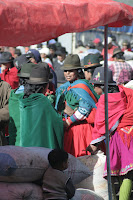 While we waited we started exploring the Sunday morning market. This was the first authentic Ecuadorian market that I had visited (the others were touristy; this one was just for the town and the people in it). The stalls were pretty much non-existent and everything was sold in the market. Some stalls sold pots and pans while others were just selling potatoes or bananas. They appeared to all be manned by the family that produced the crops. They even had a stand that was cooking cui for people to eat later.
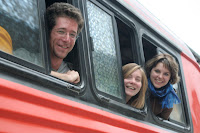 When we got back to the train station we found out that the tour group wasn't coming so we were able to make it on the 9:45 train. When it finally arrived we were able to see that the train wasn't actually a train, but a bus that had been refurbished to fit on the train tracks. In the past you were able to sit on the roof of the bus/train in order to better see the scenery, but after an unfortunate accident involving two Japanese tourists and a telephone wire, this isn't allowed anymore. Instead we sat inside the train/bus to observe the scenery.
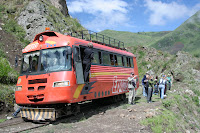 Not far outside Alausí is La Nariz del Diable (Devil's Nose), a hill where the train descends 1,000m. This was the hardest stretch to build when they built the train from the coast to Quito (hence the name) and the decent is accomplished through a series of switchbacks. We didn't understand that the train doesn't actually turn around at these switchbacks but instead descends backwards down the track. This brought along with it a different sensation and makes for a nerve-racking ride, especially when you look over the cliff (the train actually leans into the hill at about a 15 degree angle to make sure it doesn't fall over).
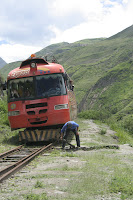 When we reached the bottom we noticed that, currently, there is no where else to go. Due to neglect, the track ends in the middle of nowhere so there's nothing else to do but turn around and head back up. After I had talked to the tour guides, they agreed to let me hop off the train at one of the switchbacks so that I could take some pictures. It was tons of fun jumping off a moving train and running alongside while it changed directions. If the scenery wasn't enough, this certainly was.
When we ended our train journey, we hopped on a bus and headed to Baños after making a quick stop in Riobamba to pick up our bags.
Anna and I arrived around 4:00pm in the afternoon and after no time at all we were able to find a great place to stay and headed off to the train station to buy the tickets. The ticket master was very quick to inform us that, sadly, there had been a landslide so the train was departing from Alausí, two hours to the south. If we stil wanted to ride on the train we would have to take a bus at six in the morning. We figured that since we had come this far, six wasn't too early.
 As I had warned Anna, there wasn't much to do in Riobamba, so it didn't take long before we had walked the strip. By 5:00pm we had run out of things to do (one hour ... that's all it took to get a hotel, buy train tickets and see everything in the town), and by that time I had already slid down a statue with the local kids. We opted to sit at a cafe and wait for Kat and Lee, but when they called to inform us they would be 6 hours late, we decided to dine without them. After dinner, Anna and I stumbled upon a performance by the local indigenous people at the train station. This performance consisted of many traditional dances, in a multitude of different costumes, all to the local folk music.
 The next morning we all got up quite early for breakfast and caught the bus at the train station to head down to Alausí. We were lucky as our bus took the road that followed the train tracks, so we were able to see the same beautiful scenery that we would have seen from the train. When we arrived in Alausí we went upstairs to try and get a ticket only to find out that the person in front of us in line got the last ticket (the price for being a nice guy and letting everyone off the bus first). We were informed that there was a 1:00pm train and there was also a chance a tour group wouldn't show up and we would be able to ride on the 9:45 train.
 While we waited we started exploring the Sunday morning market. This was the first authentic Ecuadorian market that I had visited (the others were touristy; this one was just for the town and the people in it). The stalls were pretty much non-existent and everything was sold in the market. Some stalls sold pots and pans while others were just selling potatoes or bananas. They appeared to all be manned by the family that produced the crops. They even had a stand that was cooking cui for people to eat later.
 When we got back to the train station we found out that the tour group wasn't coming so we were able to make it on the 9:45 train. When it finally arrived we were able to see that the train wasn't actually a train, but a bus that had been refurbished to fit on the train tracks. In the past you were able to sit on the roof of the bus/train in order to better see the scenery, but after an unfortunate accident involving two Japanese tourists and a telephone wire, this isn't allowed anymore. Instead we sat inside the train/bus to observe the scenery.
 Not far outside Alausí is La Nariz del Diable (Devil's Nose), a hill where the train descends 1,000m. This was the hardest stretch to build when they built the train from the coast to Quito (hence the name) and the decent is accomplished through a series of switchbacks. We didn't understand that the train doesn't actually turn around at these switchbacks but instead descends backwards down the track. This brought along with it a different sensation and makes for a nerve-racking ride, especially when you look over the cliff (the train actually leans into the hill at about a 15 degree angle to make sure it doesn't fall over).
 When we reached the bottom we noticed that, currently, there is no where else to go. Due to neglect, the track ends in the middle of nowhere so there's nothing else to do but turn around and head back up. After I had talked to the tour guides, they agreed to let me hop off the train at one of the switchbacks so that I could take some pictures. It was tons of fun jumping off a moving train and running alongside while it changed directions. If the scenery wasn't enough, this certainly was.
When we ended our train journey, we hopped on a bus and headed to Baños after making a quick stop in Riobamba to pick up our bags.
Friday, March 14, 2008
Mar. 10 - 14 - A week in Quito
I decided to change my plans a bit this week and hung around Quito so that I would be free to spend Samana Santa with Lee, Kat and Anna. So while I stayed in Quito I opted to partake in a few day trips and have some relaxing days sitting in a cafe and exploring various museums that I felt rushed through while taking Spanish classes.
My first day in Quito, Monday, was spent mostly taking care of business (laundry, bank, emails) but I did manage to return to the Foundation Guayasimin with Anna to spend more time looking at the artwork. His work is so passionate that it was well worth the re-return. That evening Lee and I broke down and cooked a fabulous dinner for the ladies that they had been asking us to cook for about four weeks.
 Tuesday was going to be my day in the old town, which did happen but I got a little side tracked. When riding on the bus I noticed an indigenous group marching in protest and thought this could be quite interesting to join. So I got off the bus in the old town and headed to Plaza Grande where I suspected the protest was headed. Everything I had read suggests that you avoid crowds of this nature for safety reasons. But I figured I would have no problem since it was a group of mostly older people, none of which wanted to cause a problem.
 The police on the other hand weren't taking any chances. Even though they were very relaxed and chatting gleefully amongst each other, they were out in full force. I guessed that there were about 200 officers in various degrees of readiness. The most equipped was sporting full riot gear including helmet with face mask, gas mask, Plexiglas shield and enough canisters of tear gas to make Rambo look ill-equiped. Thankfully these were not used. Others were armed with nothing more than night sticks.
 As I walked around the crowd talking to people and listening to the speeches I found out this protest was put on by the indigenous people from the coast and orient. Their goal was to protect their water and land from the pollution caused by the oil drilling and mining by foreign countries. It turns out that Ecuador is in the middle of changing their constitution and the indigenous people want this to be part of the new constitution. Because of the power they hold, this is very likely to happen.
 Wednesday finally allowed me to do some climbing in the Andes. At around 7 in the morning I headed out with a tour group to attempt to climb to the Cotopaxi refuge (base camp). After picking everyone up from their hotels we started our drive to Cotopaxi. According to our guide, Francisco (with whom we spoke a mixture of English and Spanish the entire day) this was one of the best days he has ever had. He said he has never seen so much snow, let alone so many mountains in winter. We stopped numerous times along the way to take pictures Volcán Pinchincha, Volcán Rumiñahui, Volcán Iliniza Norte and Sur, Volcán Corazón and of course Volcán Cotopaxi.
 At 5,897m, Cotopaxi is the highest volcano in the world and the second highest peak in Ecuador. Our goal was to drive up as far as we could and then hike to the refuge at 4,800m (same height as Mount Blanc in France). Along the drive we were blessed with marvelous vistas of the Párama (Andean grasslands) which were speckled with bolders (some the size of cars) that were thrown there from the volcano's last erruption. We also managed to see various animals including a white tailed deer and a Colpeo (Andean fox).
Due to the amount of snow (a light dusting by Canadian standards, but Ecuadorians aren't used to driving in snow) we had to leave the car before reaching the parking lot, approximately 4,000m. From there we began our three hour hike to the refuge.
 This hike had to be one of the hardest walks in my life. The first little bit (entirely through snow and very loose gravel) was hard, but passable. The story changed once we hit the 4,500m mark. My stride grew smaller; my heart pumped faster and even talking caused me to be out of breath. Needless to say we trudged onwards. The last 300m took one hour and I had to take a rest every 5 minutes, which made it feel like I would never reach the refuge ... it looked so close. Even though it was the hardest walk of my life, reaching the refuge gave me such a feeling of accomplishment. The soup and hot chocolate they served at the refuge would have to be the best I ever had. Either that or it was because I have never put so much effort into getting to a restaurant.
 Regardless of how hard it was to get up there, going down was completely different. Each step got easier and at one point we were able to run down the hill. Once we returned to the bus we headed back to Quito where I experienced one of the common side effects of this hike .... a serious headache. By the time I got back to Quito, all I could do was lie down and try to sleep .... but even that was extremely hard.
Thursday ..... nothing happened.
 Friday on the other hand was a different story. Anna and I headed to Papallacta for a day in the hot springs. After returning to the hostel to pick up my bathing suit we headed off. At the end of the bus ride we found a lovely set of hot springs nestled in the mountains. Since it was a cold day, the steam was drifting off the pools and small low flying clouds drifted past. It made the day magical and extremely relaxing. Anna and I are already planning to go back .... even though there is not much time left in Ecuador.
My first day in Quito, Monday, was spent mostly taking care of business (laundry, bank, emails) but I did manage to return to the Foundation Guayasimin with Anna to spend more time looking at the artwork. His work is so passionate that it was well worth the re-return. That evening Lee and I broke down and cooked a fabulous dinner for the ladies that they had been asking us to cook for about four weeks.
 Tuesday was going to be my day in the old town, which did happen but I got a little side tracked. When riding on the bus I noticed an indigenous group marching in protest and thought this could be quite interesting to join. So I got off the bus in the old town and headed to Plaza Grande where I suspected the protest was headed. Everything I had read suggests that you avoid crowds of this nature for safety reasons. But I figured I would have no problem since it was a group of mostly older people, none of which wanted to cause a problem.
 The police on the other hand weren't taking any chances. Even though they were very relaxed and chatting gleefully amongst each other, they were out in full force. I guessed that there were about 200 officers in various degrees of readiness. The most equipped was sporting full riot gear including helmet with face mask, gas mask, Plexiglas shield and enough canisters of tear gas to make Rambo look ill-equiped. Thankfully these were not used. Others were armed with nothing more than night sticks.
 As I walked around the crowd talking to people and listening to the speeches I found out this protest was put on by the indigenous people from the coast and orient. Their goal was to protect their water and land from the pollution caused by the oil drilling and mining by foreign countries. It turns out that Ecuador is in the middle of changing their constitution and the indigenous people want this to be part of the new constitution. Because of the power they hold, this is very likely to happen.
 Wednesday finally allowed me to do some climbing in the Andes. At around 7 in the morning I headed out with a tour group to attempt to climb to the Cotopaxi refuge (base camp). After picking everyone up from their hotels we started our drive to Cotopaxi. According to our guide, Francisco (with whom we spoke a mixture of English and Spanish the entire day) this was one of the best days he has ever had. He said he has never seen so much snow, let alone so many mountains in winter. We stopped numerous times along the way to take pictures Volcán Pinchincha, Volcán Rumiñahui, Volcán Iliniza Norte and Sur, Volcán Corazón and of course Volcán Cotopaxi.
  At 5,897m, Cotopaxi is the highest volcano in the world and the second highest peak in Ecuador. Our goal was to drive up as far as we could and then hike to the refuge at 4,800m (same height as Mount Blanc in France). Along the drive we were blessed with marvelous vistas of the Párama (Andean grasslands) which were speckled with bolders (some the size of cars) that were thrown there from the volcano's last erruption. We also managed to see various animals including a white tailed deer and a Colpeo (Andean fox).
Due to the amount of snow (a light dusting by Canadian standards, but Ecuadorians aren't used to driving in snow) we had to leave the car before reaching the parking lot, approximately 4,000m. From there we began our three hour hike to the refuge.
 This hike had to be one of the hardest walks in my life. The first little bit (entirely through snow and very loose gravel) was hard, but passable. The story changed once we hit the 4,500m mark. My stride grew smaller; my heart pumped faster and even talking caused me to be out of breath. Needless to say we trudged onwards. The last 300m took one hour and I had to take a rest every 5 minutes, which made it feel like I would never reach the refuge ... it looked so close. Even though it was the hardest walk of my life, reaching the refuge gave me such a feeling of accomplishment. The soup and hot chocolate they served at the refuge would have to be the best I ever had. Either that or it was because I have never put so much effort into getting to a restaurant.
 Regardless of how hard it was to get up there, going down was completely different. Each step got easier and at one point we were able to run down the hill. Once we returned to the bus we headed back to Quito where I experienced one of the common side effects of this hike .... a serious headache. By the time I got back to Quito, all I could do was lie down and try to sleep .... but even that was extremely hard.
Thursday ..... nothing happened.
 Friday on the other hand was a different story. Anna and I headed to Papallacta for a day in the hot springs. After returning to the hostel to pick up my bathing suit we headed off. At the end of the bus ride we found a lovely set of hot springs nestled in the mountains. Since it was a cold day, the steam was drifting off the pools and small low flying clouds drifted past. It made the day magical and extremely relaxing. Anna and I are already planning to go back .... even though there is not much time left in Ecuador.
Sunday, March 9, 2008
Mar. 8-9 - Return to Mindo
This weekend I decided to return to Mindo with Lee, Anna and Kat to show them the town and it's beauty. As is always the case, traveling to Mindo was a challenge since I was arriving in Quito from the overnight bus and was going to meet them all in the morning for the 9:00 bus (the last one of the day) to Mindo. Simple enough ... right? Well the only problem is that no one told me where to meet them. Lee and Kat decided to meet at 9:30 without telling Anna. They wanted me to call Anna, even though I didn't have her phone number. All of this including the simple fact that the bus leaves at 9:00. So I had to wander around the city to visit our usual locations before finding Anna at a random bus station .... not one of our usual locations. By now it was time for us to get Kat, so we sent Lee on the Kat finding mission and an hour later had success. It wasn't until 11am that we managed to hop on a bus heading in the right direction and would drop us off at the turn-off from the main road to Mindo....about 14km from town.
Once we got off the bus we opted to take a combineta down to the town and headed off to the same hostel I stayed at before. Once there I was greeted again by Cladudia who instantly started grilling me about why I hadn't returned to Mindo. Now, a week after I had left she was able to provide me with a description of the project I was to have done when I was last there. Still, I know I made the correct decision to change projects.
 After settling in and having dinner, we headed off to the frong concert. Yes, that's right, Mindo's main attraction in the evening (aside from the three karaoke bars) is the frong concert. This is an hour long walk after dusk through some ponds where you listen and try to find 19 different species of frongs. It was a lot of fun wandering around in the dark listening to them. The most interesting thing was wood covered with local algae, which glows in the dark.
 The best part of the evening was waiting for dusk when we were blessed with the presence of no less than 20 humming birds flying around less than six feet in front of us. This is one of the things for which Mindo is known.
The next morning Kat took a little while to get ready, so we had a later than expected start to the day, but we were going to make sure it was a full day.
 The first stop of the day was at the Cascadas des Nambillo, which required a very bumpy taxi ride back up the same road I took to my first volunteer project. The entrance to these waterfalls is by a rickety cable car that crosses a deep ravine. By any standards, this shouldn't have been safe, but who was I to argue.
The other side provided us with a three hour walk up and down hills and around about seven waterfalls (or at least that's what the map said .... we only saw three). The first of these waterfalls had what appeared to be a hacienda beside it, which we all thought would be a great place to stay, aside from the constant roar of the waterfalls and the sheer cliff you had to scale to reach the top.
 After our lovely hike in the woods, we started our walk back to town. On the way back we stopped at the zip-line course so that Kat, Anna and Lee coudl experience the same joy I had when I went through a few weeks earlier. Sadly they didn't find it as much fun as I did. Once back in town we had a quick bite then headed back to Quito.
Once we got off the bus we opted to take a combineta down to the town and headed off to the same hostel I stayed at before. Once there I was greeted again by Cladudia who instantly started grilling me about why I hadn't returned to Mindo. Now, a week after I had left she was able to provide me with a description of the project I was to have done when I was last there. Still, I know I made the correct decision to change projects.
 After settling in and having dinner, we headed off to the frong concert. Yes, that's right, Mindo's main attraction in the evening (aside from the three karaoke bars) is the frong concert. This is an hour long walk after dusk through some ponds where you listen and try to find 19 different species of frongs. It was a lot of fun wandering around in the dark listening to them. The most interesting thing was wood covered with local algae, which glows in the dark.
 The best part of the evening was waiting for dusk when we were blessed with the presence of no less than 20 humming birds flying around less than six feet in front of us. This is one of the things for which Mindo is known.
The next morning Kat took a little while to get ready, so we had a later than expected start to the day, but we were going to make sure it was a full day.
 The first stop of the day was at the Cascadas des Nambillo, which required a very bumpy taxi ride back up the same road I took to my first volunteer project. The entrance to these waterfalls is by a rickety cable car that crosses a deep ravine. By any standards, this shouldn't have been safe, but who was I to argue.
The other side provided us with a three hour walk up and down hills and around about seven waterfalls (or at least that's what the map said .... we only saw three). The first of these waterfalls had what appeared to be a hacienda beside it, which we all thought would be a great place to stay, aside from the constant roar of the waterfalls and the sheer cliff you had to scale to reach the top.
 After our lovely hike in the woods, we started our walk back to town. On the way back we stopped at the zip-line course so that Kat, Anna and Lee coudl experience the same joy I had when I went through a few weeks earlier. Sadly they didn't find it as much fun as I did. Once back in town we had a quick bite then headed back to Quito.
Subscribe to:
Posts (Atom)
